Angle à l'intersection de deux cercles concentriques
Détermination des coordonnées de l'intersection \(I\)
On cherche à déterminer l'angle qui se situe dans l'intersection de deux cercles concentriques.
On a deux cercles concentriques \((C_1, \ C_2)\) dans un repère :
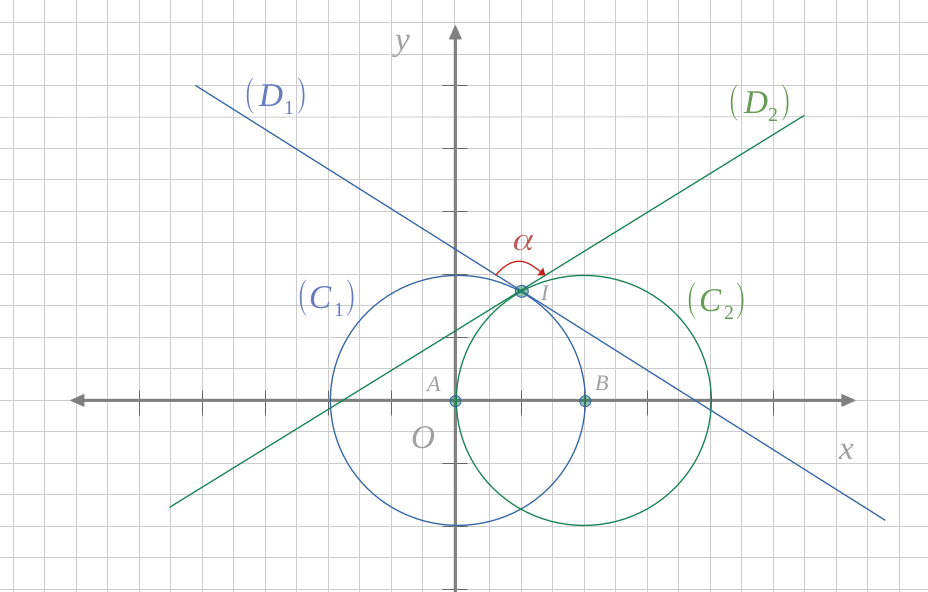
Un cercle de centre \(\Omega\bigl[a, \ b \bigr]\) et de rayon \(R\) a pour équation générale :
$$ (x - a)^2 + (y - b)^2 = R^2 $$
Comme l'un a comme centre \(\bigl(0, \ 0 \bigr)\) et le second \(\bigl(2, \ 0 \bigr)\), leurs équations respectives sont :
$$ \left \{ \begin{gather*} x^2 + y^2 = 4 \hspace{4.5em} (C_1) \\ (x-2)^2 + y^2 = 4 \qquad (C_2) \end{gather*} \right \} $$
$$ \left \{ \begin{gather*} x^2 + y^2 = 4 \\ x^2 + y^2 = 4 \\ x^2 + y^2 = 4 \\ (x-2)^2 + y^2 = 4 \end{gather*} \right \} $$
Alors pour déterminer l'intersection de ces deux cercles, comme les deux membres de droite sont égaux, on peut directectement résoudre :
$$ x^2 + y^2 = (x-2)^2 + y^2 $$
$$ \cancel{x^2} + \cancel{y^2} = \cancel{x^2} -4x + 4 + \cancel{y^2} $$
$$ 0 = -4x + 4 $$
$$ 4x = 4 $$
$$ x = \frac{4}{4} $$
$$ x = 1 $$
(était évident sur la figure, mais pour rester sur un aspect théorique)
Pour déterminer sa coordonnée \(y\), on remplace par une des équations (fonctionne avec les deux) :
$$ x^2 + y^2 = 4 \hspace{4.5em} (C_1) $$
En remplaçant avec \((x = 1)\) :
$$ 1^2 + y^2 = 4 $$
$$ y^2 = 4 - 1 $$
$$ y = \pm \sqrt{3} $$
Mais nous voulons la valeur positive ici, donc :
$$ y = \sqrt{3} $$
On a trouvé les coordonnées de l'intersection : \(I\bigl[1, \ \sqrt{3} \bigr]\).
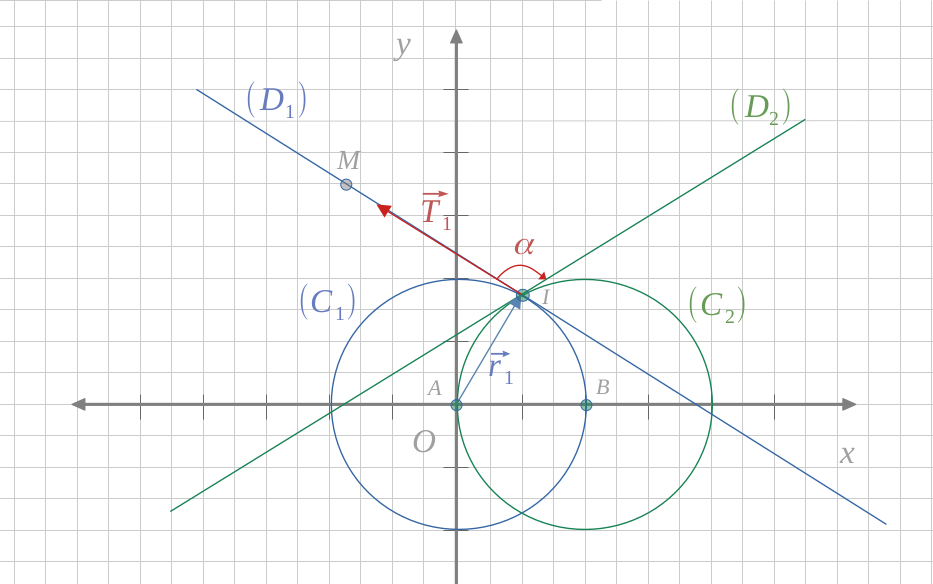
Détermination du vecteur rayon \(\overrightarrow{r_1}\) et du vecteur directeur de la tangente \(\overrightarrow{T_1}\)
Ce point va nous permettre de déterminer un vecteur rayon \(\vec{a}\) :
$$ \overrightarrow{r_1} = \begin{pmatrix} x_I - x_A \\ y_I - y_A \end{pmatrix} $$
$$ \overrightarrow{r_1} = \begin{pmatrix} 1 - 0 \\ \sqrt{3} - 0 \end{pmatrix} $$
$$ \overrightarrow{r_1} = \begin{pmatrix} 1 \\ \sqrt{3} \end{pmatrix} $$
On détermine maintenant le vecteur tangente :
Deux vecteurs sont orthogonaux si et seulement si leur produit scalaire est nul :
$$ \vec{u} \text{ et } \vec{v} \text{ orthogonaux } \Longleftrightarrow \vec{u}\cdot \vec{v} = 0 $$
$$ \overrightarrow{r_1}\cdot\overrightarrow{T_1} = 0 $$
$$ \begin{pmatrix} 1 \\ \sqrt{3} \end{pmatrix}.\begin{pmatrix} x_{\overrightarrow{T_1}} \\ y_{\overrightarrow{T_1}} \end{pmatrix} = 0 $$
$$ x_{\overrightarrow{T_1}} + \sqrt{3} \times y_{\overrightarrow{T_1}} = 0 $$
Si on fixe la coordonnée \((x_{\overrightarrow{T_1}} = 1)\), on peut déterminer sa coordonnée \(y_{\overrightarrow{T_1}}\) correspondante :
$$ 1 + \sqrt{3} \times y_{\overrightarrow{T_1}} = 0 $$
$$ 1 = - \sqrt{3} \times y_{\overrightarrow{T_1}} $$
$$ -\frac{1}{\sqrt{3}} = y_{\overrightarrow{T_1}} $$
$$ y_{\overrightarrow{T_1}} = - \frac{\sqrt{3}}{3}$$
On a alors une version du vecteur tangente :
$$ \overrightarrow{T_1} = \begin{pmatrix} 1 \\ - \frac{\sqrt{3}}{3} \end{pmatrix} $$
Détermination de l'équation de la droite tangente
Soit un point \(M\) mobile sur la droite \(\mathscr{D_1}\).
Deux vecteurs sont colinéaires si et seulement si leur déterminant est nul :
$$ det \left(\overrightarrow{u}, \ \overrightarrow{v} \right) = 0 $$
$$ det \left(\overrightarrow{T_1}, \ \overrightarrow{IM} \right) = 0 $$
$$ 1 \times (y - \sqrt{3}) - \left(- \frac{\sqrt{3}}{3} \times (x - 1) \right) = 0 $$
$$ y - \sqrt{3} + \frac{\sqrt{3}}{3} (x - 1) = 0 $$
$$ y + \frac{\sqrt{3}}{3} x - 4\frac{\sqrt{3}}{3} = 0 $$
$$ 3y + \sqrt{3}x - 4\sqrt{3} = 0 \qquad (\mathscr{D_1}) $$
Si l'on refait tout ce processus, mais de l'autre côté pour \(\mathscr{D_2}\), on trouve :
$$ \overrightarrow{r_2} = \begin{pmatrix} - 1 \\ \sqrt{3} \end{pmatrix} $$
$$ \overrightarrow{T_2} = \begin{pmatrix} 1 \\ \frac{\sqrt{3}}{3} \end{pmatrix} $$
$$ y - \sqrt{3}x - 2\sqrt{3} = 0 \qquad (\mathscr{D_2}) $$
Détermination de l'angle \(\alpha\) entre les deux droites
Pour déterminer l'angle \(\alpha\), on peut se servir des deux formules du produit scalaire qui sont :
$$ \vec{u}\cdot\vec{v} = ||\vec{u}|| \times ||\vec{v}|| \times \cos(\vec{u}, \vec{v}) \qquad (1) $$
$$ \vec{u}\cdot \vec{v} = xx' + yy' +zz' \qquad (2) $$
Avec \((1)\) et \((2)\), on a :
$$ ||\vec{u}|| \times ||\vec{v}|| \times \cos(\vec{u}, \vec{v}) = xx' + yy' +zz'$$
$$ \cos(\vec{u}, \vec{v}) = \frac{xx' + yy' +zz'}{||\vec{u}|| \times ||\vec{v}||} $$
$$ (\vec{u}, \vec{v}) = \operatorname{Arccos} \left( \frac{xx' + yy' +zz'}{||\vec{u}|| \times ||\vec{v}||} \right) \qquad (3) $$
On applique ensuite ces formules aux vecteurs \((\overrightarrow{T_1}, \ \overrightarrow{T_2})\) :
$$ (\overrightarrow{T_1}, \ \overrightarrow{T_2}) = \operatorname{Arccos} \left( \frac{1 \times 1 + \left (-\frac{\sqrt{3}}{3} \times \frac{\sqrt{3}}{3} \right)} {\sqrt{1^2 + \left
(-\frac{\sqrt{3}}{3} \right)^2 } \times \sqrt{1^2 + \left (\frac{\sqrt{3}}{3} \right)^2 }} \right) $$
$$ (\overrightarrow{T_1}, \ \overrightarrow{T_2}) = \operatorname{Arccos} \left( \frac{\frac{2}{3}} {\sqrt{\frac{4}{3} } \times \sqrt{\frac{4}{3}}} \right) $$
$$ (\overrightarrow{T_1}, \ \overrightarrow{T_2}) = \operatorname{Arccos} \left( \frac{2}{3} \times \frac{3}{4}\right) $$
$$ (\overrightarrow{T_1}, \ \overrightarrow{T_2}) = \operatorname{Arccos} \left( \frac{1}{2} \right) $$
$$ (\overrightarrow{T_1}, \ \overrightarrow{T_2}) = \frac{\pi}{3} \qquad( = 60°) $$
Angle à l'intersection de deux cercles concentriques
On cherche à déterminer l'angle qui se situe dans l'intersection de deux cercles concentriques.
On a deux cercles concentriques \((C_1, \ C_2)\) dans un repère :
.png)
L'angle situé à l'intersection des deux cercles concentriques vaut :
$$ \alpha = \operatorname{Arccos} \left( \frac{r_1^2 + r_2^2 - AB^2} {2 r_1 r_2 } \right) $$
Dans votre cas :
$$ \alpha = \operatorname{Arccos} \left( \frac{2^2 + 2^2 - 2^2} {2 \times 2 \times 2 } \right) $$
$$ \alpha = \operatorname{Arccos} \left( \frac{4} {8} \right) $$
$$ \alpha = \operatorname{Arccos} \left( \frac{1} {2} \right) $$
$$ \alpha = \frac{\pi}{3} \qquad( = 60°) $$
Détermination de l'aire d'une lentille symétrique
Pour cette partie, je ne saurai pas le démontrer mais :
L'aire d'une lentille symétrique se calcule par :
$$ A = R^2 \bigl(\theta - \sin(\theta)\bigr) $$
$$ \text{avec} \enspace\left \{ \begin{gather*} R : \text{ rayon du cercle} \\ \theta : \text{ longueur d'arc} \end{gather*} \right \} $$
Dans votre cas, cela donne :
$$ A = 2^2 \left[\frac{\pi}{3} - \sin\left(\frac{\pi}{3}\right)\right] $$
$$ A \approx 0{,}725 \text{ u.a. } $$

 Retour