


 Retour
Fonction carrée : détermination de variations et intersection
Soit la fonction \(\Gamma\) suivante :
-
Déterminer l'ensemble de définition \(D_{\Gamma}\) de la fonction \(\Gamma\).
La fonction \(\Gamma\) est définie partout, n'ayant aucune valeur interdite.
$$ D_{\Gamma} = \mathbb{R} $$ -
Déterminer les variations de \(\Gamma\) sur \(\mathbb{R^+}\) et \(\mathbb{R^-}\), puis tracer ces variations dans un tableau.
On pourra s'aider d'un encadrement déterminer ces variations :
$$ \forall x \in \mathbb{R^+}, \ f(x) = x^2 \ est \ strictement \ croissante, $$Alors,
$$ \forall (a,b) \in \bigl[ \mathbb{R^+} \bigr]^2, \ a \leqslant b \Longleftrightarrow a^2 \leqslant b^2 $$$$ \forall x \in \mathbb{R^-}, \ f(x) = x^2 \ est \ strictement \ d\textit{é}croissante, $$Alors,
$$ \forall (a,b) \in \bigl[ \mathbb{R^+} \bigr]^2, \ a \leqslant b \Longleftrightarrow a^2 \geqslant b^2 $$Pour \(x < 0\) :
$$ a \leqslant b $$$$ a^2 \geqslant b^2 $$$$ -\frac{1}{2} a^2 \leqslant -\frac{1}{2} b^2 $$$$ \Gamma(a) \leqslant \Gamma(b) $$$$ a \leqslant b \Longrightarrow \Gamma(a) \leqslant \Gamma(b) $$Alors, la fonction \(\Gamma\) est croissante sur \(\mathbb{R}^*_-\).
Pour \(x \geqslant 0\) :
$$ a \leqslant b $$$$ a^2 \leqslant b^2 $$$$ -\frac{1}{2} a^2 \geqslant -\frac{1}{2} b^2 $$$$ \Gamma(a) \geqslant \Gamma(b) $$$$ a \leqslant b \Longrightarrow \Gamma(a) \geqslant \Gamma(b) $$Alors, la fonction \(\Gamma\) est décroissante sur \(\mathbb{R}^+\).
$$ x $$$$ -\infty $$$$ 0 $$$$ +\infty $$$$ \Gamma(x) = -\frac{1}{2}x^2 $$ $$ 0 $$
-
Soit une autre fonction \(\Delta\) :$$ \Delta(x) = -\frac{1}{4}x $$
Trouver les intervalles de solutions pour \(x\) de l'équation suivante :
$$ \Gamma(x) = \Delta(x) $$$$ \Gamma(x) = \Delta(x) \qquad (E) $$$$ -\frac{1}{2}x^2 = -\frac{1}{4}x $$$$ -\frac{1}{2}x^2 +\frac{1}{4}x = 0 $$$$ \frac{1}{2}x \left( -x + \frac{1}{2} \right) = 0 $$$$ \frac{1}{2}x = 0 x = 0 $$ou
$$ -x + \frac{1}{2} = 0 x = \frac{1}{2} $$Alors, l'intervalle des solutions pour \((E)\) est :
$$ \mathcal{S} = x \in \left \{ 0, \frac{1}{2} \right \} $$
Ensembles de définition
-
Déterminer les ensembles de définition des fonctions suivantes :$$ f(x) = \frac{1}{\sqrt{x}} $$$$ g(x) = \frac{1}{x-1} $$$$ h(x) = \sqrt{2x+1} $$$$ i(x) = \frac{1}{x} + \frac{1}{x-1} + \frac{1}{x-2} $$$$ j(x) = \frac{1}{1-x} + \sqrt{2x} $$$$f(x) = \frac{1}{\sqrt{x}} $$
Pour que la fonction \(\sqrt{x}\) soit définie, il faut que :
$$ x \geqslant 0 $$et
Pour que le dénominateur ne s'annule pas, il faut que :
$$ \sqrt{x} \neq 0 $$$$ x \neq 0 $$Soit comme intersection des deux :
$$ (x \geqslant 0) \land (x \neq 0) = x > 0 $$$$ \mathcal{D}_f = \mathbb{R^*_+} $$
$$g(x) = \frac{1}{x-1} $$Pour que le dénominateur ne s'annule pas, il faut que :
$$ x-1 \neq 0 $$$$ x \neq 1 $$$$ \mathcal{D}_g = \mathbb{R} \hspace{0.2em} \backslash \left\{ 1 \right\} $$
$$h(x) = \sqrt{2x+1} $$Pour que la fonction \(\sqrt{2x+1}\) soit définie, il faut que :
$$ 2x+1 \geqslant 0 $$$$ 2x \geqslant -1 $$$$ x \geqslant -\frac{1}{2} $$$$ \mathcal{D}_h = \left[ -\frac{1}{2} ; +\infty\right] $$
$$i(x) = \frac{1}{x} + \frac{1}{x-1} + \frac{1}{x-2} $$Pour que la fonction \(i\) soit définie, il faut qu'aucun dénominateur ne s'annule, soit :
$$ x \neq 0 $$et
$$ x -1 \neq 0 x \neq 1 $$et
$$ x -2 \neq 0 x \neq 2 $$$$ \mathcal{D}_i = \mathbb{R} \hspace{0.2em} \backslash \bigr\{ 0, 1, 2 \bigl\} $$
$$j(x) = \frac{1}{1-x} + \sqrt{2x} $$Pour que la fonction \(j\) soit définie, il faut que :
$$ 1-x \neq 0 x \neq 1 $$$$ 2x \geqslant 0 x \geqslant 0 $$Soit comme intersection des deux :
$$ (x \neq 1) \land (x \geqslant 0) = \mathbb{R}^+ \hspace{0.2em} \backslash \bigr\{ 1 \bigl\} $$$$ \mathcal{D}_j = \mathbb{R}^+ \hspace{0.2em} \backslash \bigr\{ 1 \bigl\} $$
Parités de fonctions
Pour ces différentes fonctions, indiquer leur parité.
-
Pour ces différentes fonctions, indiquer leur parité (paire, impaire ou aucune des deux) :$$ f(x) = \frac{1}{x} + x $$$$ g(x) = \frac{1}{x^2} $$$$ h(x) = |x| - 1 $$$$ i(x) = x^3 + x^2 $$$$ j(x) = x + x^3 - x^5 $$$$f(x) = \frac{1}{x} + x $$
Calcul de \(f(-x)\)
$$ f(-x) = \frac{1}{-x} - x $$$$ f(-x) = -\frac{1}{x} - x $$$$ f(-x) = - \left( \frac{1}{x} + x \right) $$$$f(-x) = - f(x) $$Alors, c'est une fonction impaire .
$$g(x) = \frac{1}{x^2} $$Calcul de \(g(-x)\)
$$ g(-x) =\frac{1}{(-x)^2} $$$$ g(-x) =\frac{1}{x^2} $$$$g(-x) = g(x) $$Alors, c'est une fonction paire .
$$h(x) = |x| - 1 $$Calcul de \(h(-x)\)
$$ h(-x) = |-x| - 1 $$$$ h(-x) = |x| - 1 $$$$h(-x) = h(x) $$Alors, c'est une fonction paire .
$$i(x) = x^3 + x^2 $$Calcul de \(i(-x)\)
$$ i(-x) = (-x)^3 + (-x)^2 $$$$ i(-x) = -x^3 + x^2 $$$$ i(-x) \neq i(x) $$Cette fonction n'est pas paire .
Calcul de \(-i(x)\)
$$ -i(x) = -\left( x^3 + x^2 \right) $$$$ -i(x) = -x^3 - x^2 $$$$ i(-x) \neq -i(x) $$Cette fonction n'est pas impaire .
Alors, cette fonction n'est ni paire, ni impaire .
$$j(x) = x + x^3 - x^5 $$Calcul de \(j(-x)\)
$$ j(-x) = -x + (-x)^3 + (-x)^5 $$$$ j(-x) = -x - x^3 - x^5 $$$$ j(-x) = - \left( x + x^3 - x^5 \right) $$$$j(-x) = -j(x) $$Alors, c'est une fonction paire .
-
Démontrer qu'une fonction somme de deux fonctions paires est une fonction paire.
Soit deux fonctions \((f,g)\) telles que :
$$ \Biggl \{ \begin{gather*} f(x) = f(-x) \\ g(x) = g(-x) \end{gather*} $$On introduit aussi une nouvelle fonction somme \(\Sigma(x)\) telle que :
$$ \Sigma(x) = f(x) + g(x) $$Alors,
$$ \Sigma(-x) = f(-x) + g(-x) $$$$ \Sigma(-x) = f(x) + g(x) $$$$\Sigma(-x) = \Sigma(x) $$Alors, on a démontré que la somme de deux fonctionspaires était aussi une fonction paire .
-
Démontrer qu'une fonction somme de deux fonctions impaires est une fonction impaire.
Soit deux fonctions \((f,g)\) telles que :
$$ \Biggl \{ \begin{gather*} f(-x) = -f(x) \\ g(-x) = -g(x) \end{gather*} $$On introduit aussi une nouvelle fonction somme \(\Sigma(x)\) telle que :
$$ \Sigma(x) = f(x) + g(x) $$Alors,
$$ \Sigma(-x) = f(-x) + g(-x) $$$$ \Sigma(-x) = -f(x) - g(x) $$$$ \Sigma(-x) = - \bigl(f(x) + g(x) \bigr) $$$$\Sigma(-x) = - \Sigma(x) $$Alors, on a démontré que la somme de deux fonctions impaires était aussi une fonction impaire .
-
Démontrer qu'une fonction produit d'une fonction impaire et d'une fonction paire est une fonction impaire.
Soit deux fonctions \((f,g)\) telles que :
$$ \Biggl \{ \begin{gather*} f(-x) = -f(x) \\ g(-x) = g(x) \end{gather*} $$On introduit aussi une nouvelle fonction produit \(\Pi(x)\) telle que :
$$ \Pi(x) = f(x) g(x) $$Alors,
$$ \Pi(-x) = f(-x) g(-x) $$$$ \Pi(-x) = -f(x) g(x) $$$$\Pi(-x) = -\Pi(x) $$Alors, on a démontré que le produit d'une fonction impaire et d'une fonction paire était une fonction impaire .
Fonction carré : modélisation de la température dans le désert
L'évolution de la température (en \(°C\)) dans un désert a été modélisée sur une journée (\(t\) en \(h\)) par :
-
Représenter la courbe de cette fonction sur le graphique suivant.
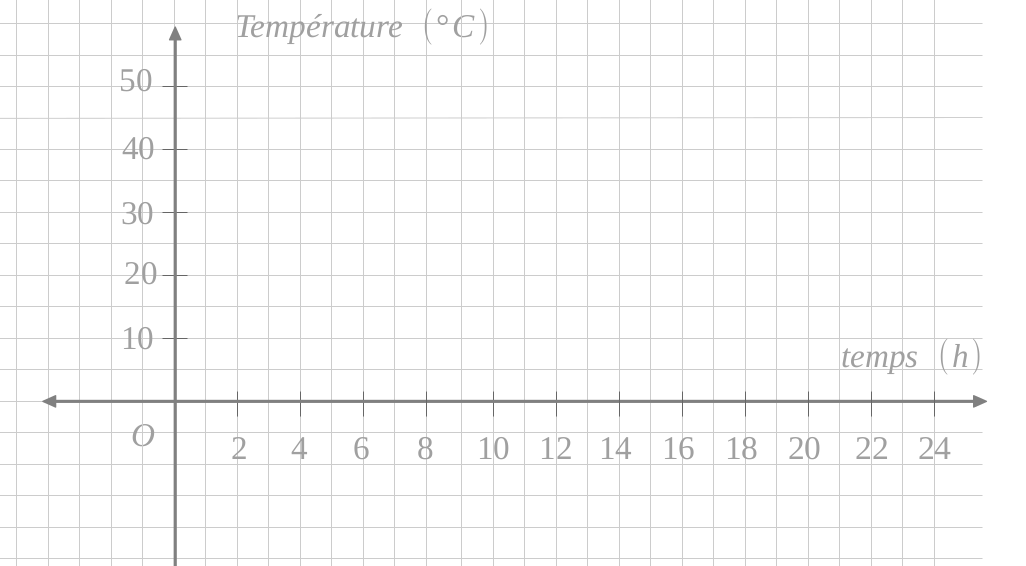
graphique représentant la température (en \(°C\)) en fonction des heures d'une journée (à compléter) 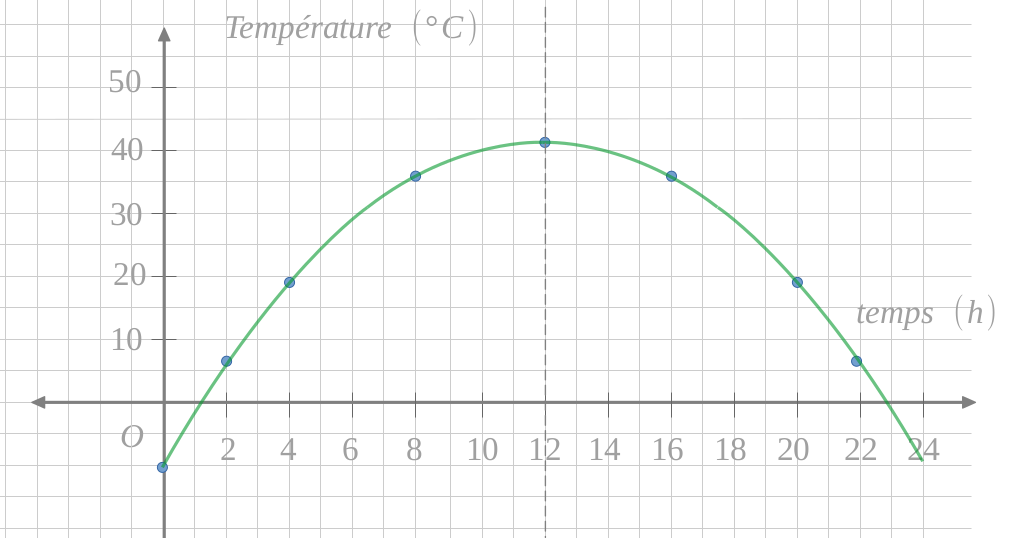
graphique représentant la température (en \(°C\)) en fonction des heures d'une journée -
À quelle heure de la journée la température semble être maximale ?
La témpérature semble être maximale à \((t=12)\), c'est-à-dire à midi.
-
Cette fonction admet semble admettre un axe de symétrie en \((x=12)\), vérifier alors que :$$ T(12-t) = T(12+t) $$
Calcul de \(T(12-t)\) :
$$ T(12-t) = -\frac{9}{25}((12- t) -12)^2 + 42 $$$$ T(12-t) = -\frac{9}{25}(-t)^2 + 42 $$$$ T(12-t) = -\frac{9}{25}t^2 + 42 $$Calcul de \(T(12+t)\) :
$$ T(12+t) = -\frac{9}{25}((12 + t) -12)^2 + 42 $$$$ T(12+t) = -\frac{9}{25}t^2 + 42 $$On a bien vérifié que :
$$T(12-t) = T(12+t) $$ -
Quelle sont les températures à \((t = 0)\) et \((t = 24)\) ? Cela semble-t-il cohérent ?$$ T(0) = -9.84 $$$$ T(24) = -9.84 $$
Cela vérifie bien la symétrie précédemment étudiée.
-
Résoudre graphiquement :$$ T(t) \geqslant 26 $$
Puis vérifier ce résultat par le calcul .
Graphiquement, on trouve que :
$$ T(t) \geqslant 26 \Longrightarrow t \in \bigl[\approx 5.3 ; \approx 18.6 \bigr] $$
Maintenant, algébriquement :
$$ T(t) \geqslant 26 \qquad(E) $$$$ -\frac{9}{25}(t-12)^2 + 42 \geqslant 26 $$$$ -\frac{9}{25}(t-12)^2 \geqslant 26 - 42 $$$$ -\frac{9}{25}(t-12)^2 \geqslant -16 $$$$ (t-12)^2 \geqslant -16 \times \left( -\frac{25}{9} \right) $$$$ (t-12)^2 \geqslant \frac{16 \times 25}{9} $$$$ (t-12)^2 - \frac{16 \times 25}{9} \geqslant 0 $$$$ (t-12)^2 - \frac{4^2 \times 5^2}{3^2} \geqslant 0 $$$$ (t-12)^2 - \left( \frac{4\times 5}{3} \right)^2 \geqslant 0 $$$$ (t-12)^2 - \left( \frac{20}{3} \right)^2 \geqslant 0 $$On peut maintenant factoriser avec la troisième identité remarquable, on a :
$$ \left[(t-12) - \frac{20}{3} \right ] \left[(t-12) + \frac{20}{3} \right ] \leqslant 0 $$$$ \left[\textcolor{#6187B2}{\frac{3}{3} \times } (t-12) - \frac{20}{3} \right ] \left[ \textcolor{#6187B2}{\frac{3}{3} \times }(t-12) + \frac{20}{3} \right ] \leqslant 0 $$$$ \left(\frac{3t- 36 -20 }{3} \right ) \left(\frac{3t- 36 + 20 }{3} \right) \leqslant 0 $$$$ \left(\frac{3t-56}{3} \right) \left(\frac{3t-16 }{3} \right ) \leqslant 0 $$$$ \bigl(3t-56\bigr) \bigl(3t-16 \bigr ) \leqslant 0 \qquad(E') $$
Pour les racines des différents facteurs :
$$ 3t-56 = 0 3t = 56 t = \frac{56}{3} $$$$ 3t-16 = 0 5t = 16 t = \frac{16}{3} $$$$ x $$$$ -\infty $$$$ \frac{16}{3} $$$$ \frac{56}{3} $$$$ +\infty $$$$ 3t-56 $$$$ \textcolor{rgb(232 124 124)}{-} $$$$ \textcolor{rgb(232 124 124)}{-} $$$$ \textcolor{rgb(232 124 124)}{-} $$$$ 0 $$$$ \textcolor{rgb(93 183 129)}{+} $$$$ 3t-16 $$$$ \textcolor{rgb(232 124 124)}{-} $$$$ 0 $$$$ \textcolor{rgb(93 183 129)}{+} $$$$ \textcolor{rgb(93 183 129)}{+} $$$$ \textcolor{rgb(93 183 129)}{+} $$$$ \bigl(3t-56 \bigr) \bigl(3t-16 \bigr ) $$$$ \textcolor{rgb(93 183 129)}{+} $$$$ 0 $$$$ \textcolor{rgb(232 124 124)}{-} $$$$ 0 $$$$ \textcolor{rgb(93 183 129)}{+} $$Les solutions pour \((E')\) et donc pour \((E)\) sont :
$$ \mathcal{S} = x \in \left[ \frac{16}{3} ; frac{56}{3} \right] $$C'est cohérent avec la lecture graphique car :
$$ \frac{16}{3} \approx 5.3 $$$$ \frac{56}{3} \approx 18.6 $$
Résolution d'inéquations avec les fonctions de référence
Pour chaque cas, résoudre graphiquement , puis algébriquement :
-
la fonction inverse et une fonction constante :
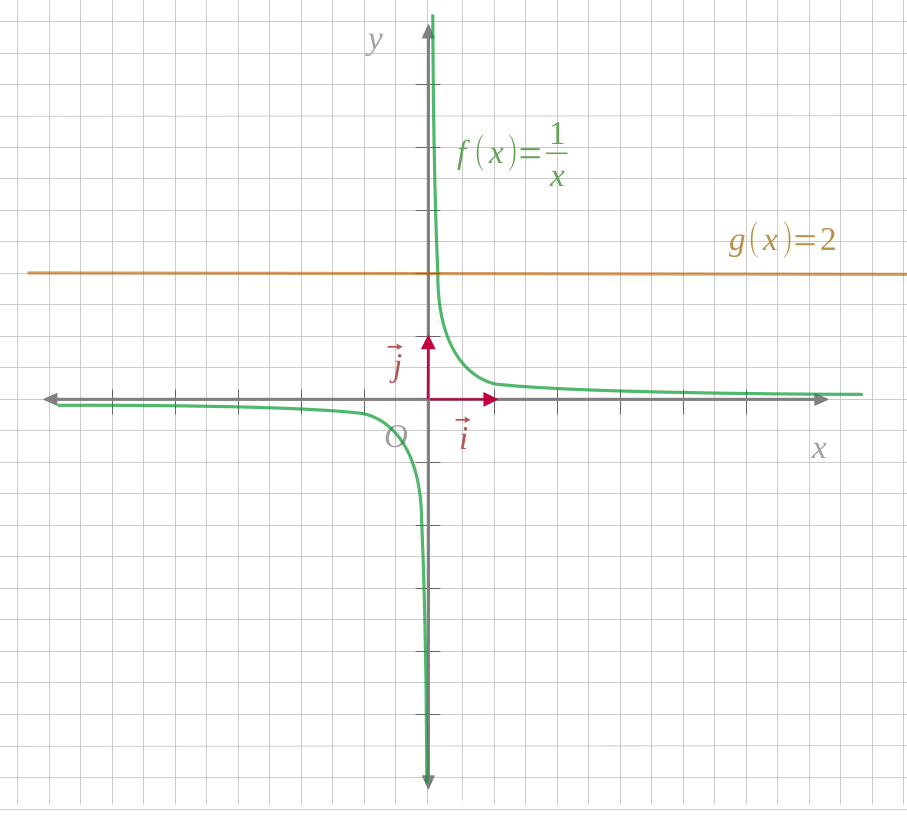
graphique représentant la fonction inverse et une fonction constante $$ \frac{1}{x} \geqslant 2 \qquad(E) $$-
Intervalle de travail
On travaille sur l'intersection des ensembles de définition respectifs de chaque fonction :
$$ f(x) = \frac{1}{x} \mathcal{D}_f = \mathbb{R}^* $$$$ g(x) = 2 \mathcal{D}_g =\mathbb{R} $$$$ \mathcal{D}_E = \mathcal{D}_f \cap \mathcal{D}_g $$$$ \mathcal{D}_E = \mathbb{R}^* \cap \mathbb{R} $$$$ \mathcal{D}_E = \mathbb{R}^* $$ -
Factorisation
$$ \frac{1}{x} \geqslant 2 $$$$ \frac{1}{x} - 2 \geqslant 0 $$$$ \frac{1}{x} - \frac{2x}{x} \geqslant 0 $$$$ \frac{1 -2x}{x} \geqslant 0 \qquad(E') $$ -
Tableau de signes
Pour les racines des différents facteurs :
$$ 1-2x = 0 1 = 2x x = \frac{1}{2} $$$$ x = 0 $$$$ x $$$$ -\infty $$$$ 0 $$$$ \frac{1}{2} $$$$ +\infty $$$$ 1 - 2x $$$$ \textcolor{rgb(93 183 129)}{+} $$$$ \textcolor{rgb(93 183 129)}{+} $$$$ \textcolor{rgb(93 183 129)}{+} $$$$ 0 $$$$ \textcolor{rgb(232 124 124)}{-} $$$$ x $$$$ \textcolor{rgb(232 124 124)}{-} $$$$ 0 $$$$ \textcolor{rgb(93 183 129)}{+} $$$$ \textcolor{rgb(93 183 129)}{+} $$$$ \textcolor{rgb(93 183 129)}{+} $$$$ \frac{1 -2x}{x} $$$$ \textcolor{rgb(232 124 124)}{-} $$ $$ \textcolor{rgb(93 183 129)}{+} $$$$ 0 $$$$ \textcolor{rgb(232 124 124)}{-} $$
 -
Conclusion
Les solutions pour \((E')\) :
$$ \frac{1 -2x}{x} \geqslant 0 \qquad(E') $$et donc aussi pour \((E)\) sont :
$$ \mathcal{S} = x \in \left] 0 ; frac{1}{2} \right] $$
-
-
la fonction inverse et la fonction identité :
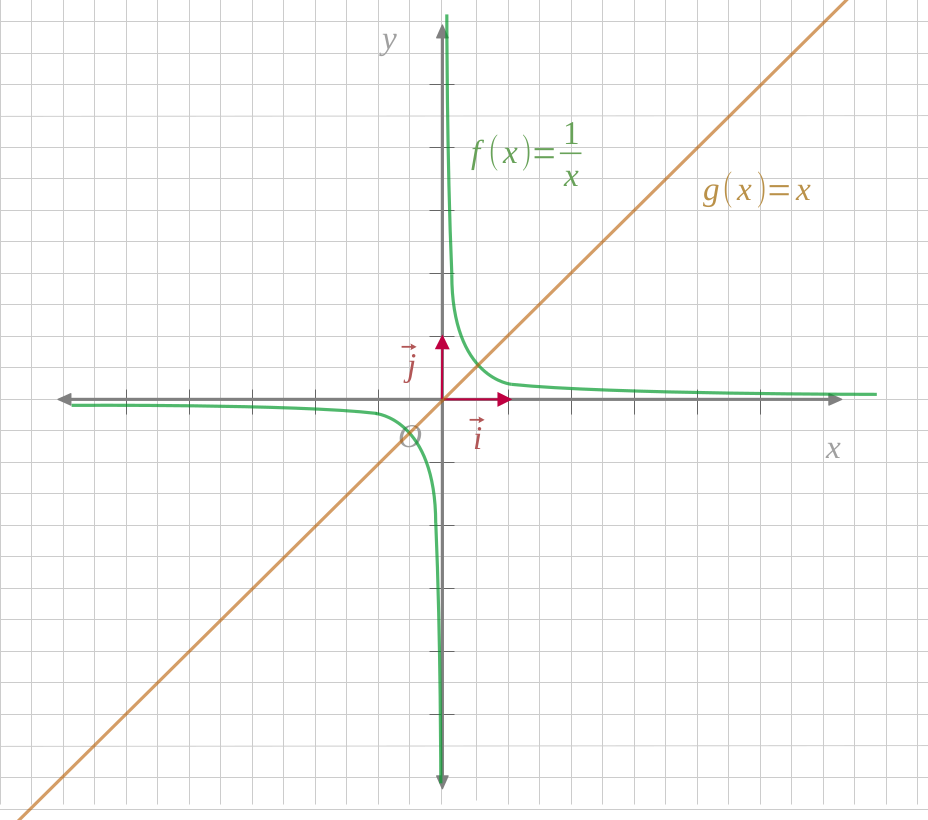
graphique représentant la fonction inverse et la fonction identité $$ \frac{1}{x} \geqslant x \qquad(F) $$-
Intervalle de travail
On travaille sur l'intersection des ensembles de définition respectifs de chaque fonction :
$$ f(x) = \frac{1}{x} \mathcal{D}_f = \mathbb{R}^* $$$$ g(x) = x \mathcal{D}_g =\mathbb{R} $$$$ \mathcal{D}_F = \mathcal{D}_f \cap \mathcal{D}_g $$$$ \mathcal{D}_F = \mathbb{R}^* \cap \mathbb{R} $$$$ \mathcal{D}_F = \mathbb{R}^* $$ -
Factorisation
$$ \frac{1}{x} \geqslant x $$$$ \frac{1}{x} - x \geqslant 0 $$$$ \frac{1}{x} - \frac{x^2}{x} \geqslant 0 $$$$ \frac{1 -x^2}{x} \geqslant 0 $$$$ \frac{(1-x)(1+x)}{x} \geqslant 0 \qquad(F') $$ -
Tableau de signes
Pour les racines des différents facteurs :
$$ 1-x = 0 1 = x $$$$ 1+x = 0 x = -1 $$$$ x = 0 $$$$ x $$$$ -\infty $$$$ -1 $$$$ 0 $$$$ 1 $$$$ +\infty $$$$ 1 - x $$$$ \textcolor{rgb(93 183 129)}{+} $$$$ \textcolor{rgb(93 183 129)}{+} $$$$ \textcolor{rgb(93 183 129)}{+} $$$$ \textcolor{rgb(93 183 129)}{+} $$$$ \textcolor{rgb(93 183 129)}{+} $$$$ 0 $$$$ \textcolor{rgb(232 124 124)}{-} $$$$ 1 + x $$$$ \textcolor{rgb(232 124 124)}{-} $$$$ 0 $$$$ \textcolor{rgb(93 183 129)}{+} $$$$ \textcolor{rgb(93 183 129)}{+} $$$$ \textcolor{rgb(93 183 129)}{+} $$$$ \textcolor{rgb(93 183 129)}{+} $$$$ \textcolor{rgb(93 183 129)}{+} $$$$ x $$$$ \textcolor{rgb(232 124 124)}{-} $$$$ \textcolor{rgb(232 124 124)}{-} $$$$ \textcolor{rgb(232 124 124)}{-} $$$$ 0 $$$$ \textcolor{rgb(93 183 129)}{+} $$$$ \textcolor{rgb(93 183 129)}{+} $$$$ \textcolor{rgb(93 183 129)}{+} $$$$ \frac{1 -2x}{x} $$$$ \textcolor{rgb(93 183 129)}{+} $$$$ 0 $$$$ \textcolor{rgb(232 124 124)}{-} $$
$$ \textcolor{rgb(93 183 129)}{+} $$$$ 0 $$$$ \textcolor{rgb(232 124 124)}{-} $$ -
Conclusion
Les solutions pour \((F')\) :
$$ \frac{(1-x)(1+x)}{x} \geqslant 0 \qquad(F') $$et donc aussi pour \((F)\) sont :
$$ \mathcal{S} = x \in \bigl] -\infty; -1 \bigr] \cup \bigl] 0 ; 1 \bigr] $$
-
-
la fonction carré et la fonction cube :
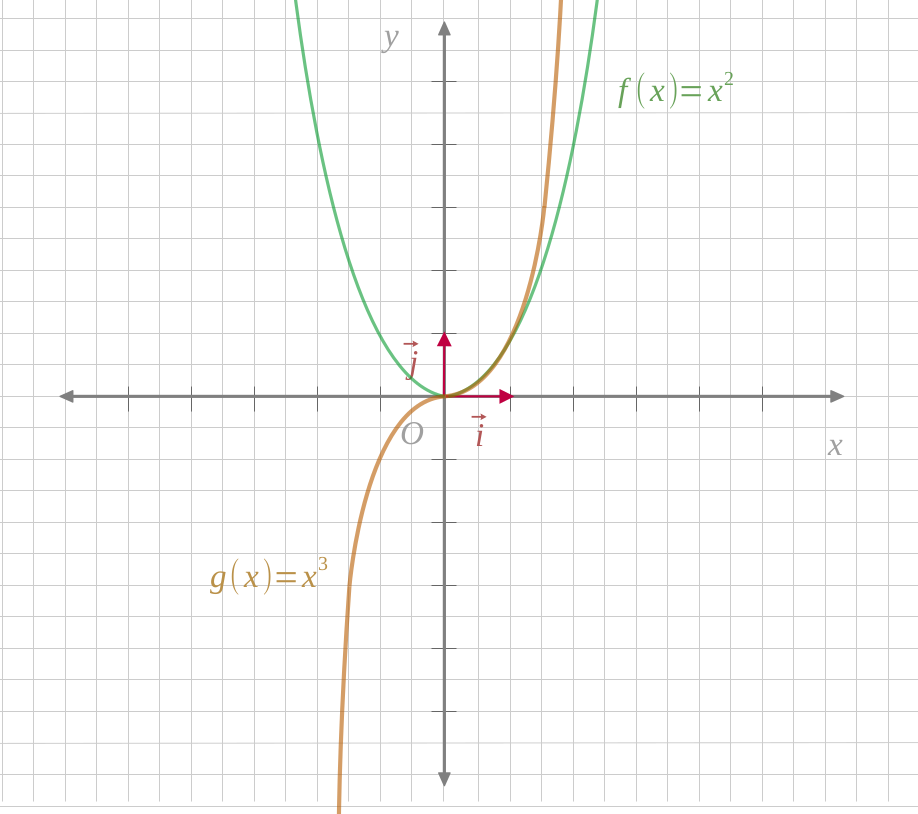
graphique représentant la fonction carré et la fonction cube $$ x^2 \geqslant x^3 \qquad(G) $$-
Intervalle de travail
Comme il n'y a aucune valeur interdite, on travaille sur \(\mathbb{R}\).
$$ \mathcal{D}_G = \mathbb{R} $$ -
Factorisation
$$ x^2 \geqslant x^3 $$$$ x^2 - x^3 \geqslant 0 $$$$ x^2(1-x) \geqslant 0 \qquad(G') $$ -
Tableau de signes
Pour les racines des différents facteurs :
$$ x^2= 0 x = 0 $$$$ 1-x = 0 x = 1 $$$$ x $$$$ -\infty $$$$ 0 $$$$ 1 $$$$ +\infty $$$$ x^2 $$$$ \textcolor{rgb(93 183 129)}{+} $$$$ 0 $$$$ \textcolor{rgb(93 183 129)}{+} $$$$ \textcolor{rgb(93 183 129)}{+} $$$$ \textcolor{rgb(93 183 129)}{+} $$$$ 1-x $$$$ \textcolor{rgb(93 183 129)}{+} $$$$ \textcolor{rgb(93 183 129)}{+} $$$$ \textcolor{rgb(93 183 129)}{+} $$$$ 0 $$$$ \textcolor{rgb(232 124 124)}{-} $$$$ x^2(1-x) $$$$ \textcolor{rgb(93 183 129)}{+} $$$$ 0 $$$$ \textcolor{rgb(93 183 129)}{+} $$$$ 0 $$$$ \textcolor{rgb(232 124 124)}{-} $$ -
Conclusion
Les solutions pour \((G')\) :
$$ x^2(1-x) \geqslant 0 \qquad(G') $$et donc aussi pour \((G)\) sont :
$$ \mathcal{S} = x \in \bigl] -\infty; 1 \bigr] $$
-
-
la fonction carré et la fonction carré inverse :
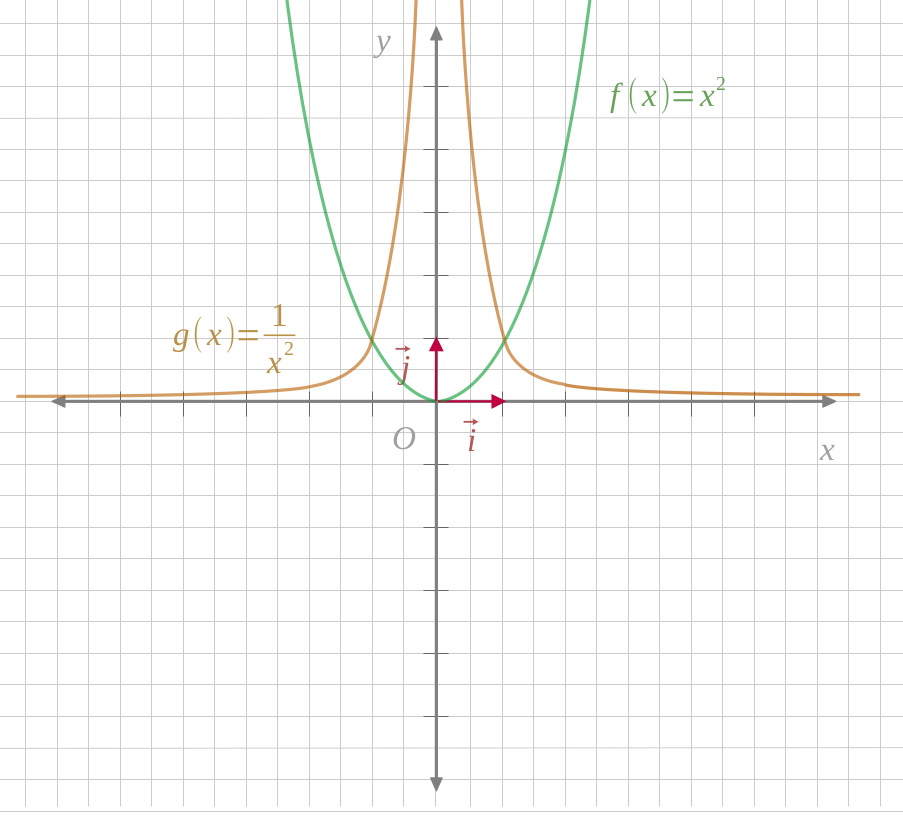
graphique représentant la fonction carré et la fonction carré inverse $$ x^2 \geqslant \frac{1}{x^2} \qquad(H) $$-
Intervalle de travail
On travaille sur l'intersection des ensembles de définition respectifs de chaque fonction :
$$ f(x) = x^2 \mathcal{D}_f = \mathbb{R} $$$$ g(x) = \frac{1}{x^2} \mathcal{D}_g = \mathbb{R}^* $$$$ \mathcal{D}_H = \mathcal{D}_f \cap \mathcal{D}_g $$$$ \mathcal{D}_H = \mathbb{R} \cap \mathbb{R}^* $$$$ \mathcal{D}_H = \mathbb{R}^* $$ -
Factorisation
$$ x^2 \geqslant \frac{1}{x^2} $$$$ x^2 - \frac{1}{x^2} \geqslant 0 $$$$ \frac{x^4}{x^2} - \frac{1}{x^2} \geqslant 0 $$$$ \frac{x^4 - 1}{x^2} \geqslant 0 $$$$ \frac{(x^2 - 1)(x^2 + 1)}{x^2} \geqslant 0 $$$$ \frac{(x - 1)(x+1)(x^2 + 1)}{x^2} \geqslant 0 \qquad(H') $$ -
Tableau de signes
Pour les racines des différents facteurs :
$$ x-1 = 0 x = 1 $$$$ x + 1 = 0 x = -1 $$$$ x^2 + 1 = 0 $$Pas de racine.
$$ x^2 = 0 x = 0 $$$$ x $$$$ -\infty $$$$ -1 $$$$ 0 $$$$ 1 $$$$ +\infty $$$$ x - 1 $$$$ \textcolor{rgb(232 124 124)}{-} $$$$ \textcolor{rgb(232 124 124)}{-} $$$$ \textcolor{rgb(232 124 124)}{-} $$$$ \textcolor{rgb(232 124 124)}{-} $$$$ \textcolor{rgb(232 124 124)}{-} $$$$ 0 $$$$ \textcolor{rgb(93 183 129)}{+} $$$$ x + 1 $$$$ \textcolor{rgb(232 124 124)}{-} $$$$ 0 $$$$ \textcolor{rgb(93 183 129)}{+} $$$$ \textcolor{rgb(93 183 129)}{+} $$$$ \textcolor{rgb(93 183 129)}{+} $$$$ \textcolor{rgb(93 183 129)}{+} $$$$ \textcolor{rgb(93 183 129)}{+} $$$$ x^2 + 1 $$$$ \textcolor{rgb(93 183 129)}{+} $$$$ \textcolor{rgb(93 183 129)}{+} $$$$ \textcolor{rgb(93 183 129)}{+} $$$$ \textcolor{rgb(93 183 129)}{+} $$$$ \textcolor{rgb(93 183 129)}{+} $$$$ \textcolor{rgb(93 183 129)}{+} $$$$ \textcolor{rgb(93 183 129)}{+} $$$$ x^2 $$$$ \textcolor{rgb(93 183 129)}{+} $$$$ \textcolor{rgb(93 183 129)}{+} $$$$ \textcolor{rgb(93 183 129)}{+} $$$$ 0 $$$$ \textcolor{rgb(93 183 129)}{+} $$$$ \textcolor{rgb(93 183 129)}{+} $$$$ \textcolor{rgb(93 183 129)}{+} $$$$ \frac{(x - 1)(x+1)(x^2 + 1)}{x^2} $$$$ \textcolor{rgb(93 183 129)}{+} $$$$ 0 $$$$ \textcolor{rgb(232 124 124)}{-} $$
$$ \textcolor{rgb(232 124 124)}{-} $$$$ 0 $$$$ \textcolor{rgb(93 183 129)}{+} $$ -
Conclusion
Les solutions pour \((H')\) :
$$ \frac{(x - 1)(x+1)(x^2 + 1)}{x^2} \geqslant 0 \qquad(H') $$et donc aussi pour \((H)\) sont :
$$ \mathcal{S} = x \in \bigl] -\infty; -1 \bigr] \cup \bigl[ 1; +\infty \bigr[ $$
-
-
la fonction valeur absolue et la fonction cube :
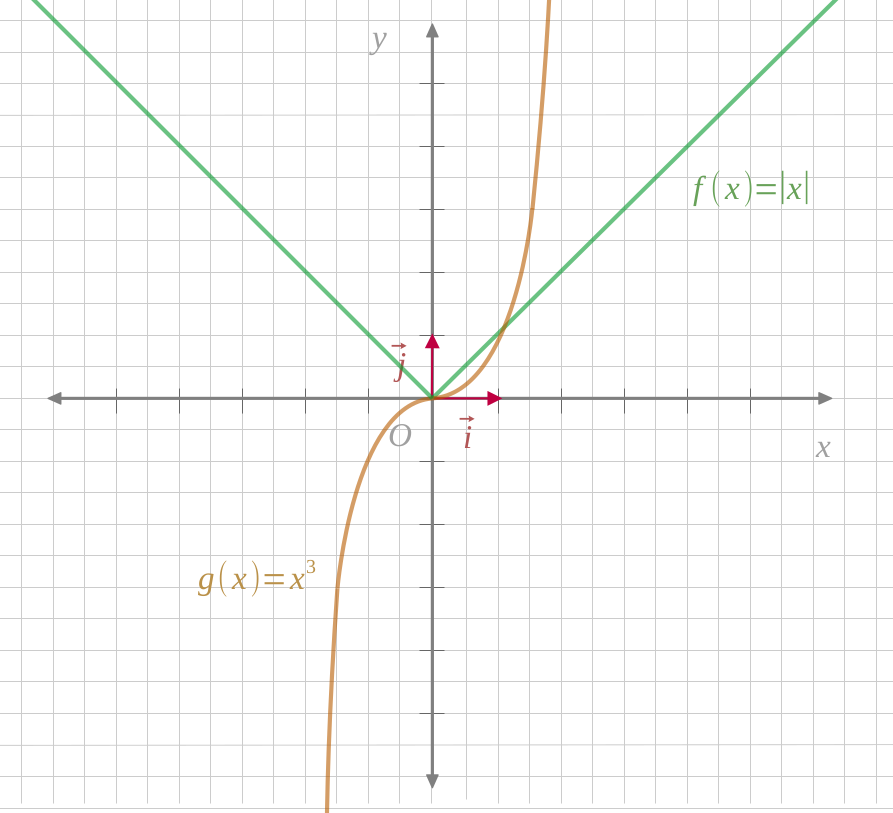
graphique représentant la fonction valeur absolue et la fonction cube $$ |x| \geqslant x^3 \qquad(I) $$-
Intervalle de travail
Aucune des deux fonctions n'admet de valeur interdite, donc :
$$ \mathcal{D}_I = \mathbb{R} $$ -
Factorisation
$$ |x| \geqslant x^3 $$Lorsque l'on traite avec des valeurs absolues, le mieux est de procéder par disjonction de cas :
$$ \Biggl \{ \begin{gather*} |x| = -x, \qquad (si \ x < 0)\\ |x| = x, \qquad (si \ x \geqslant 0) \end{gather*} $$Cas : \(x < 0\)
$$ -x \geqslant x^3 $$$$ -x - x^3 \geqslant 0 $$$$ x + x^3 \leqslant 0 $$$$ x(1+x^2) \leqslant 0 \qquad(I') $$Cas : \(x \geqslant 0\)
$$ x \geqslant x^3 $$$$ x - x^3 \geqslant 0 $$$$ x(1-x^2) \geqslant 0 $$$$ x(1-x)(1+x) \geqslant 0 \qquad(I'') $$ -
Tableau de signes
Pour les racines des différents facteurs :
$$ x = 0 $$$$ 1 + x^2 = 0 $$Pas de racine.
$$ x - 1 = 0 x = 1 $$$$ x + 1 = 0 x = -1 $$$$ x $$$$ -\infty $$$$ -1 $$$$ x $$$$ \textcolor{rgb(232 124 124)}{-} $$$$ \textcolor{rgb(232 124 124)}{-} $$$$ \textcolor{rgb(232 124 124)}{-} $$$$ 1 + x^2 $$$$ \textcolor{rgb(93 183 129)}{+} $$$$ \textcolor{rgb(93 183 129)}{+} $$$$ \textcolor{rgb(93 183 129)}{+} $$$$ x(1+x^2) $$$$ \textcolor{rgb(232 124 124)}{-} $$$$ \textcolor{rgb(232 124 124)}{-} $$$$ \textcolor{rgb(232 124 124)}{-} $$$$ x $$$$ 0 $$$$ 1 $$$$ +\infty $$$$ x $$$$ 0 $$$$ \textcolor{rgb(93 183 129)}{+} $$$$ \textcolor{rgb(93 183 129)}{+} $$$$ \textcolor{rgb(93 183 129)}{+} $$$$ 1 - x $$$$ \textcolor{rgb(93 183 129)}{+} $$$$ \textcolor{rgb(93 183 129)}{+} $$$$ 0 $$$$ \textcolor{rgb(232 124 124)}{-} $$$$ 1 + x $$$$ \textcolor{rgb(93 183 129)}{+} $$$$ \textcolor{rgb(93 183 129)}{+} $$$$ \textcolor{rgb(93 183 129)}{+} $$$$ \textcolor{rgb(93 183 129)}{+} $$$$ x(1-x)(1+x) $$$$ 0 $$$$ \textcolor{rgb(93 183 129)}{+} $$$$ 0 $$$$ \textcolor{rgb(232 124 124)}{-} $$ -
Conclusion
Les solutions pour \((I')\) et \((I'')\) :
Cas : \(x < 0\)
$$ x(1+x^2) \leqslant 0 \qquad(I') $$Cas : \(x \geqslant 0\)
$$ x(1-x)(1+x) \geqslant 0 \qquad(I'') $$et donc aussi pour \((I)\) sont :
$$ \mathcal{S} = x \in \bigl] -\infty; 1 \bigr] $$
-
-
la fonction carrée et la fonction valeur absolue :
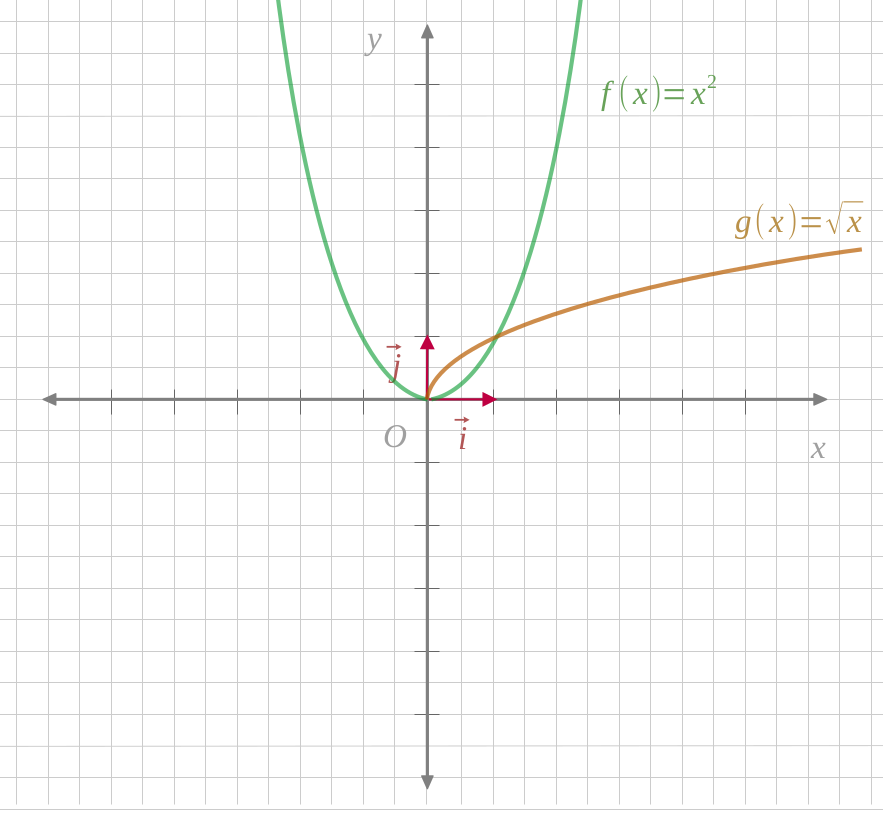
graphique représentant la fonction carrée et la fonction valeur absolue $$ x^2 \geqslant \sqrt{x} \qquad(J) $$-
Intervalle de travail
On travaille sur l'intersection des ensembles de définition respectifs de chaque fonction :
$$ f(x) = x^2 \mathcal{D}_f = \mathbb{R} $$$$ g(x) = \sqrt{x} \mathcal{D}_g = \mathbb{R}^+ $$$$ \mathcal{D}_J = \mathcal{D}_f \cap \mathcal{D}_g $$$$ \mathcal{D}_J = \mathbb{R} \cap \mathbb{R}^+ $$$$ \mathcal{D}_J = \mathbb{R}^+ $$Application de la fonction carrée
$$ x^2 \geqslant \sqrt{x} $$Ici, comme on travaille où la fonction carrée est strictement positive, on peut l'appliquer de part et d'autre de l'équation :
$$ x^4 \geqslant x $$ -
Factorisation
$$ x^4 \geqslant x $$$$ x^4 - x \geqslant 0 $$$$ x(x^3-1) \geqslant 0 \qquad(J') $$ -
Tableau de signes
Pour les racines des différents facteurs :
$$ x = 0 $$$$ x^3-1 \geqslant 0 x^3 \geqslant 1 \textcolor{#6187B2}{\sqrt[3]{\textcolor{#5E864A}{x^3}}} \geqslant \textcolor{#6187B2}{\sqrt[3]{\textcolor{#5E864A}{1}}} x \geqslant 1 $$$$ x $$$$ 0 $$$$ 1 $$$$ +\infty $$$$ x $$$$ 0 $$$$ \textcolor{rgb(93 183 129)}{+} $$$$ \textcolor{rgb(93 183 129)}{+} $$$$ \textcolor{rgb(232 124 124)}{-} $$$$ x^3 - 1 $$$$ \textcolor{rgb(232 124 124)}{-} $$$$ \textcolor{rgb(232 124 124)}{-} $$$$ 0 $$$$ \textcolor{rgb(93 183 129)}{+} $$$$ x(x^3-1) $$$$ 0 $$$$ \textcolor{rgb(232 124 124)}{-} $$$$ 0 $$$$ \textcolor{rgb(93 183 129)}{+} $$ -
Conclusion
Les solutions pour \((J')\) :
$$ x(x^3-1) \geqslant 0 \qquad(J') $$et donc aussi pour \((J)\) sont :
$$ \mathcal{S} = x \in \bigl[ 0 ; 0 \bigr] \cup \bigl[ 1; +\infty \bigr[ $$
-