L'intégrale mesure une aire sous une courbe : une primitive la calcule, ses propriétés la découpent et l'encadrent.
-
Interpréter l'intégrale d'une fonction positive comme une aire
-
Calculer une intégrale à l'aide d'une primitive
-
Utiliser la relation de Chasles, la linéarité et la positivité de l'intégrale
-
Calculer la valeur moyenne d'une fonction sur un intervalle
-
Calculer une intégrale par intégration par parties
Un compteur de vitesse relevé minute par minute ne donne pas la distance parcourue. Mais l'aire comprise sous la
courbe de la vitesse, elle, la donne exactement.
$$ d = \int_{0}^{T} v(t) \, \mathrm{d}t $$
À vitesse constante, c'est l'aire d'un rectangle ; à vitesse variable, il faut sommer une infinité de tranches.
Intégrer, c'est accumuler : l'aire sous la courbe de la vitesse est la distance parcourue.
Intégrale comme aire sous la courbe d'une fonction
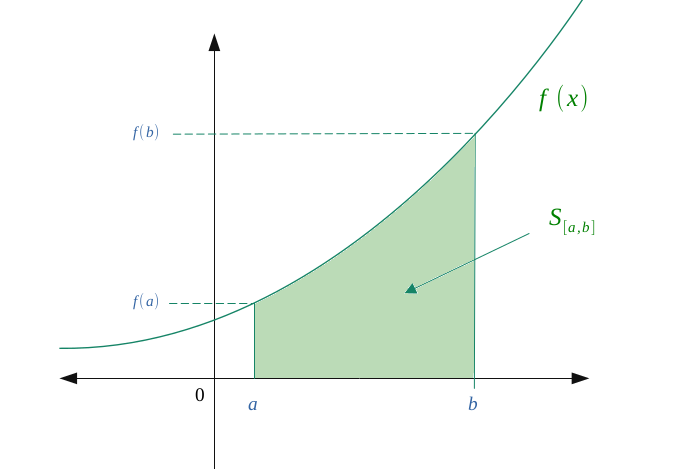
Soit une fonction \(f\) continue et positive sur un segment \(\bigl[a \ ; \ b\bigr]\), et \(F\) une primitive de \(f\).
Alors, l'aire située entre
la courbe de \(f\)
et
l'axe des abscisses
vaut :
$$ S_{a,b}= \int_a^b \ f(t) \ dt = F(b) - F(a) $$
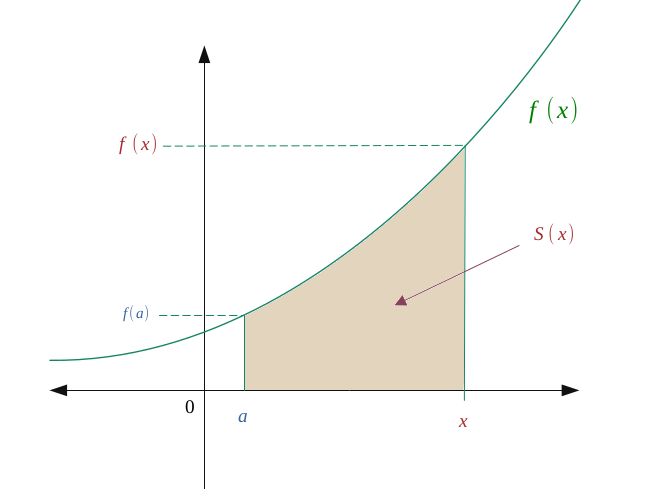
Si la borne supérieure est variable, alors cette intégrale est
la primitive de \(f\) qui s'annule en \(a\)
:
$$ S(x)= \int_a^x \ f(t) dt $$
Propriétés de l'intégrale
Soit deux fonctions \(f\) et \(g\) continues sur un intervalle \(I\), et \(F\) une primitive de \(f\).
Fonction définie par une intégrale
$$ \forall (a, x) \in D_f^2, $$
$$ F(x) = \int_{a}^x f(t) \hspace{0.2em}dt \Longrightarrow F(a) = 0$$
Intégrale de a vers a
$$ \forall a \in D_f, $$
$$ \int_{a}^a f(t) \hspace{0.2em}dt =0 $$
Intégrale de b vers a
$$ \forall (a,b) \in D_f^2, $$
$$ \int_{b}^a f(t) \hspace{0.2em}dt = -\int_{a}^b f(t) \hspace{0.2em}dt $$
Relation de Chasles
$$ \forall (a, \lambda ,b) \in D_f^3, \enspace a \leqslant \lambda \leqslant b, $$
$$ \int_{a}^{\lambda} f(t) \hspace{0.2em}dt + \int_{\lambda}^b f(t) \hspace{0.2em}dt = \int_{a}^b f(t) \hspace{0.2em}dt $$
Linéarité de l'intégrale
$$ \forall (a,b) \in D_f^2, \enspace \forall (\lambda, \mu) \in \hspace{0.05em} \mathbb{R}^2,$$
$$ \int_{a}^b \biggl(\lambda f(t) + \mu g(t) \hspace{0.2em} \biggr) dt = \lambda \int_{a}^b f(t) \hspace{0.2em}dt + \mu \int_{a}^b g(t) \hspace{0.2em}dt $$
L'intégrale d'une combinaison linéaire de fonctions est la combinaison linéaire de l'intégrale de chaque fonction.
Positivité de l'intégrale
$$ \forall (a,x, b) \in D_f^3, \enspace x \in [a, b], $$
$$ \enspace f(x) \geqslant 0 \hspace{0.2em} \Longrightarrow \hspace{0.2em} \int_{a}^b f(t) \hspace{0.2em}dt \geqslant 0 $$
De la même manière, si \( f(x) \leqslant 0 \) sur \( [a, b] \),
$$ \forall (a,x, b) \in D_f^3, \enspace x \in [a, b], $$
$$ f(x) \textcolor{rgb(232 124 124)}{\leqslant} 0 \hspace{0.2em} \Longrightarrow \hspace{0.2em} \int_{a}^b f(t) \hspace{0.2em}dt \textcolor{rgb(232 124 124)}{\leqslant} 0 $$
Croissance de l'intégrale
$$ \forall (a,x, b) \in D_f^3, \enspace x \in [a, b], $$
$$ f(x) \leqslant g(x) \hspace{0.2em} \Longrightarrow \hspace{0.2em} \int_{a}^b f(t) \hspace{0.2em}dt \leqslant \int_{a}^b g(t) \hspace{0.2em}dt $$
Valeur moyenne
$$ \forall (a,b) \in D_f^2, $$
$$ \mu = \frac{1}{(b-a)} \int_{a}^b f(t) \hspace{0.2em}dt $$
Théorème de la moyenne
$$ \forall (a,b) \in D_f^2, $$
$$ \exists c \in \hspace{0.05em} ]a,b[, \enspace f(c) = \frac{1}{(b-a)} \int_{a}^b f(t) \hspace{0.2em}dt$$
Inégalité de la moyenne
$$ \forall (a,b) \in D_f^2, \ \Bigl[ \forall x \in [a, b], \ m = \min\{f\}, \ M = \max\{f\} \Bigr], $$
$$ m \hspace{0.2em} \leqslant \hspace{0.2em} \frac{1}{(b-a)} \int_{a}^b f(t) \hspace{0.2em}dt \hspace{0.2em} \leqslant \hspace{0.2em} M $$
Méthodes d'intégration
Intégration par parties (IPP)
$$ \forall (a,b) \in D_f^2,$$
$$ \int_{a}^b (f'g) \hspace{0.2em}dt = \Bigl[fg\Bigr]_{a}^b - \int_{a}^b (fg') \hspace{0.2em}dt $$
Avec la dérivée d'un produit, on a :
$$ \left ( f g\right)' = f'g + g'f $$
$$ f'g = ( f g)' - g'f $$
Par suite, grâce à la propriété de linéarité de l'intégrale,
$$ \int_{a}^b (f'g) \hspace{0.2em}dt = \int_{a}^b (fg)' \hspace{0.2em}dt -\int_{a}^b (fg') \hspace{0.2em}dt $$
Et,
$$ \int_{a}^b (f'g) \hspace{0.2em}dt = \Bigl[fg\Bigr]_{a}^b -\int_{a}^b (fg') \hspace{0.2em}dt $$
Soit finalement,
$$ \forall (a,b) \in I^2, \enspace a < b, $$
$$ \int_{a}^b (f'g) \hspace{0.2em}dt = \Bigl[fg\Bigr]_{a}^b - \int_{a}^b (fg') \hspace{0.2em}dt $$



 Retour